
Solstice Seeds

Dark Skies and Wide Horizons

A dark sky dispatch from the Dark Sky Community of Norwood, Colorado

By Ellen Metrick

President, Norwood (Colorado) Dark Sky Advocates

Dec. 21, 2024

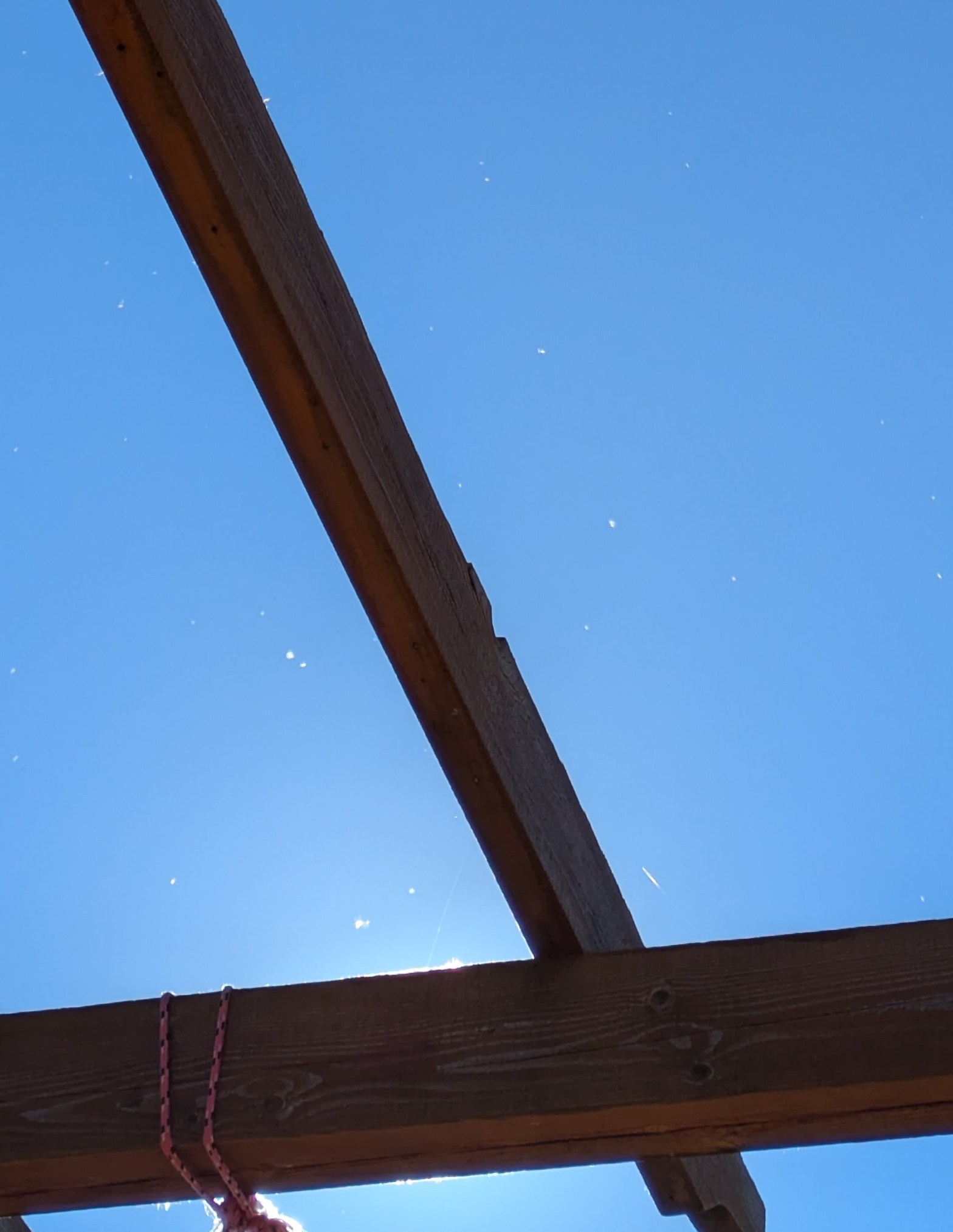
It’s not snow that flies through the morning blue skies, it’s cattail fluff, breeze-borne seeds on this bright winter solstice morning. Yesterday, honey bees searched green garlands for food. The only snow visible from my home at 7,000’ in Southwest Colorado, at the edge of Norwood’s Dark Sky Community, is on the peaks and in small patches and runs along the shady edges of pasture grasses. 

While the ground is dry, much drier than we like it, the skies have been clear. We’ve seen the space station pass over this month, Jupiter and the moon setting together, Mercury just before sunrise, Mars at sunset, and the green dashes of meteor showers punctuating early morning hours. 

It’s a good day to meditate on what we’re letting go and what we’re embracing in the coming season. We’ve been cocooned in darkness, and slowly, now, the light returns, and like any good worthy work, it takes time. It’s not sudden like a meteor streak; it’s work that lasts. 

We have a few sky events to look forward to this month. The second new moon of December is on the 30th. It’s rare to have two new moons in a month, and some call this the dark moon, as opposed to the blue moon of two full moons in a month. 

A black moon is as rare as a blue moon, happening about every 33 months. The next black moon will be August 23, 2025, in most of the world. We’ll have to wait longer for a blue moon — May 31, 2026. 

Black moon isn’t an official term, and there are other definitions for it. It can also mean a third  new moon in an astronomical season which has four new moons — that’s in  the weeks between solstice and equinox, equinox and solstice. Solstice and equinox vary between the 20th and 22nd days of Dec., March, June and Sept. 

As the moon wanes towards darkness this season, it’s a good time to continue inner discovery  and reflection, and prepare the seeds for the coming year, whether you celebrate the new year on solstice or Dec. 31. This new year, the moon will be returning on Jan. 1, 2025, beginning its first day of waxing, a strong day for new year’s intentions. 

Lumin/ahhhh/sity

for Bob and Doug 

specked your little brightness
traveling our starscape
Saturday night, then your 
earlier interview, just an hour 
before, your farewells
from the station made your light
shine warmer knowing the beings
in the luminosity, and next day -- 
to see you splash down earth
birth from Dragon's belly
ahhh, darkness and descent
and light, light, light, and 
welcome back from your sky
walk, seared, stellar, shining,
ahhh, your light across our lives


Whitewater Rafting, Parenting, and Coronavirus

When my daughter decided to lodge herself in my uterus, I hadn’t exactly planned for being pregnant. I had told my partner that if we did somehow end up with a fertilized seed, I would carry the child and raise them. He agreed. Two months later, we were pregnant. Like she’d just been waiting for the right time, my daughter’s little eventuality became reality. I embraced it fully. Mostly. There were hiccups, gas, depression, loneliness, fear, and other attendant difficulties, but I wouldn’t trade it. Ever. Parenting is a ride of vulnerability and growth if nothing else, and that’s my favorite part of it. Right now, it’s especially challenging, more than ever, with a teenager who is a year from launching into the world and is stuck at home due to state and county COVID19 sheltering orders. So far, we’re sheltered.

My dreams lately have a lot of children in them. Children being playful with each other, dogs, dads, and lions. Sometimes they’re scary. Last night, a six-year-old boy came up and threw water on me. I told him that it’s dangerous to do that right now. This isn’t a normal summer. He shouldn’t play that way.

This morning I find myself wondering about statistics. How likely am I to get Coronavirus? How likely am I to die from it? How do those numbers measure up to all the other risks I take on a daily basis? I drive a car, commute by bike along a two-lane state highway with no shoulder, and spend too much time on the computer these days. Other risks include a lack of exercise because I have too much stress and I’m not regulating my seat time. And, I drink unpasteurized milk. Oh, and I didn’t mention — I teach. In a public school. Where studies have shown that the keyboards of teachers have 27 times more germs than those of any other professional anywhere. That’s why most of us are teaching from home right now.

In the Time Before, I also traveled by airplane a couple of times each year and made monthly trips of about 700  miles by car. In my youth, I boated class 5 rivers on a regular basis for two decades, had occasional unprotected sex with possibly trustworthy partners, drank a lot, surfed and spent time in ocean waters, lived in my van in questionable areas, made my home in a tipi for three years and in a cane shack for one, and in the latter, it was not unusual for rats to run across our sleeping bodies. I know, because they often woke me up.

So, is living with coronavirus just learning to live with more risks? What can I do to lessen the risk? We wear masks and gloves in town, especially at the grocery store, and we social distance … but what about my kid? Everything she’s exposed to, I’m exposed to. And she’s getting antsy for social interaction beyond Zoom rooms and Netflix parties. We are having a lot of conversations about how she can be a teenager and still keep both of us safe. She gets it. That’s what makes it harder. My current growth — as a parent and as a human — is a combination of risk assessment and play. I did it all the time when showing up at a put-in for a river trip and scouting routes through rapids. Now, I’m doing it on a river I can’t see.

The next obvious question after assessment is, how can I prepare myself for flipping? In boating, we “rig to flip”, even if we’re on flatwater. It’s a kind of practical prayer and bargain: if we tie everything down and double-check the frame and gear straps, we’ll have minimal to no loss if we do flip, and maybe it’ll actually prevent us from flipping (the river guides’ equivalent of taking an umbrella so it won’t rain). So, how do we prepare for Coronavirus so that if we do get it, we won’t drown? That’s really the million-dollar question, and answer, isn’t it?

Of course, I could stop asking all of these questions and stay on the shore — that is, stay at home and not have any contact with people and continue to keep my 17-year-old away from other people. I don’t have to choose to be vulnerable and grow and learn. I never had to choose to descend burly rivers with class V rapids. However, while the flatwater is gorgeous, the adrenaline is fun. It’s all about play, about safety and risking as safely as we can.


Planning for Grief in the Middle of Everything

Maybe it’s because I’m listening to Brene Brown and David Kessler. Their conversation today on Brene’s podcast “Unlocking Us” brings understandings forward that I may not otherwise have. We are all dealing with the collective loss of the world we knew, says Kessler. I think often about losing the world I know, especially when my daughter or my partner doesn’t show up or call back when I expect. In the middle of everything, I plan ahead for grief and somehow it leads me. Grief steps in immediately and begins to manage my response to losing them. I know I’m not paranoid: I’m an overcompensater, I remind myself, and I like to plan ahead. I always take too much food on trips, I always have the first aid kit or at least a bandaid! I look around rooms that I’m in or spaces I’m moving through and catalogue items I can use in an emergency. I note things that could go wrong and think through my potential, constructive responses in such scenarios. I run through the mental checklist when I leave the house and when I know someone else is leaving the house, especially when I am not there. I stay my fingers from texts like, “Did you turn off the oven?” or “Is the dog out?” or “Did you remember your dance bag?”.

I also have a checklist for responding to potential loss.  For example, right now I’m home early after what was supposed to be a day away. I can’t contact my partner and I’m in heavy planning for how I will respond. I never thought of it as a grief response, but maybe that’s what it is. Using the five “stages” or areas of grief as a template, I go right through acceptance and imagine how I will make meaning. Making meaning is a part of grief that Kessler discovered when he lost his son; it doesn’t show up in the original work he and Elisabeth Kübler-Ross did, but they had talked about it, he says. It’s an important part of the process, and really for re-entry into the every day after a loss.

We’re in loss right now due to the life that a virus has ended for all of us on the entire planet. It’s not just individual or group loss; it’s being experienced by our whole species. So, how do I make meaning in the middle of a grief I couldn’t have planned for? How do I, we make meaning in the thick of (probably not the middle yet — that’s a long way off) this pandemic that is changing the world as we knew it?

I’m at that planning to make meaning point now. I’ve called my partner four times — every hour since I was done what I was doing, and no answer. There are no messages, either. In the shower just now, rinsing off the day, I noticed that I took a step back from caring. It’s like the acceptance step, except that the only acceptance there is to be had right now is that I’ll hear from B when I do. That’s not the acceptance I go to, though. I go overboard and start accepting that it’s over. For whatever reason — there’s been an accident, a decision, a leaving, a change of mind. It doesn’t matter. I’m protecting myself by being proactively accepting of a loss that has very likely not happened. I know. Sounds ridiculous, but it’s where I go.

My daughter has told me recently that she doesn’t want to just see and be with her friends. That’s not enough. She wants to touch them, hug them, snuggle, kiss. Therefore, since those ways of connecting are out of the question at this moment, she doesn’t want to see her friends at all. Maybe I’m doing the same thing. I’m at the point that I don’t want B to answer the phone when I call next time. I’m ready to turn my phone off. I’m unable now to think about welcoming B home because somehow I’ve already slipped into the acceptance place that there is no homecoming, so I’m planning my next steps already.

It’s entirely possible I did this after my husband died. It’s also, therefore, entirely possible that I’m doing it now. In my mind, I’m like, okay — so, we’re in a new world. I’ll live in it however I need to. The thing is, the loss we’re facing is potentially that of our own lives. It’s no different than any other day, and yet somehow, it is. How do we make meaning ahead of a loss? How can we plan ahead for grief, and still find meaning in this new reality?


Asking Questions

Beginning by asking questions. The main one, What engages students in their own learning? Reading Leaders of Their Own Learning (Berger, 2014), and working at bringing intentional learning targets into the classroom with student engagement. I am feeling like I need partners or, better yet, a mentor to whom I can put my own questions, but for now am journaling to help myself analyze my own process.

I wrote one learning goal (“I can determine the central idea of an informational text” (RI7.2)) up on the board yesterday with 7th grade, after watching several of the videoed classroom sessions from the cd that came with Berger’s book. The shift of responsibility from me to students was immediately tangible, obvious by suddenly-upright body postures, eyes on the board, and hands in the air. I used the language from one of the videos, “What do you notice or wonder about this learning target?” I had immediate responses from students. They asked questions and noticed words. We discussed the target, and then I asked for a fist-to-five response, a student self-assessment on how they each thought they could meet this target. I had a couple of fours, several threes and twos, and a few ones. I asked what was difficult, and it was the phrase “central idea.” Changing the word central to main brought three or four more students up to a four, but we still had four who weren’t clear on what main idea is. I explained. It didn’t help. A student tried, to no avail. I had them discuss in their table groups, and, amazingly for me, heard the ah-haas go around the room after about a minute! Continue reading “Asking Questions”